Writing
70 Searches a Month: What a Thin Market Does to Google Ads
I pulled the real search volume for search services across five regional Queensland cities, then ran it live. The auction told me more than the research did.

I wanted a proper answer to a question I get asked most weeks. How much search volume does a regional Queensland business actually have to work with before Google Ads becomes worth the money?
So I ran the research on the keyword set I know best, which is my own service category. Search-related services, in the towns I work across. Then I built a live campaign on it, because the research tells you what Google thinks the volume is and the auction tells you what happens when you turn up to bid on it. Those are not the same thing, and the gap between them is the part I had never measured properly.
The research
I ran the volumes as a ladder rather than a single pull, because a single pull only tells you whether a number is big or small, not where the threshold sits.
Cairns alone first. Then Cairns plus Townsville. Then the full cluster of Cairns, Townsville, Mackay, Rockhampton and Toowoomba. Then Queensland. Then Australia. That way you can see the point at which volume actually turns on, instead of jumping straight to statewide and over-correcting.
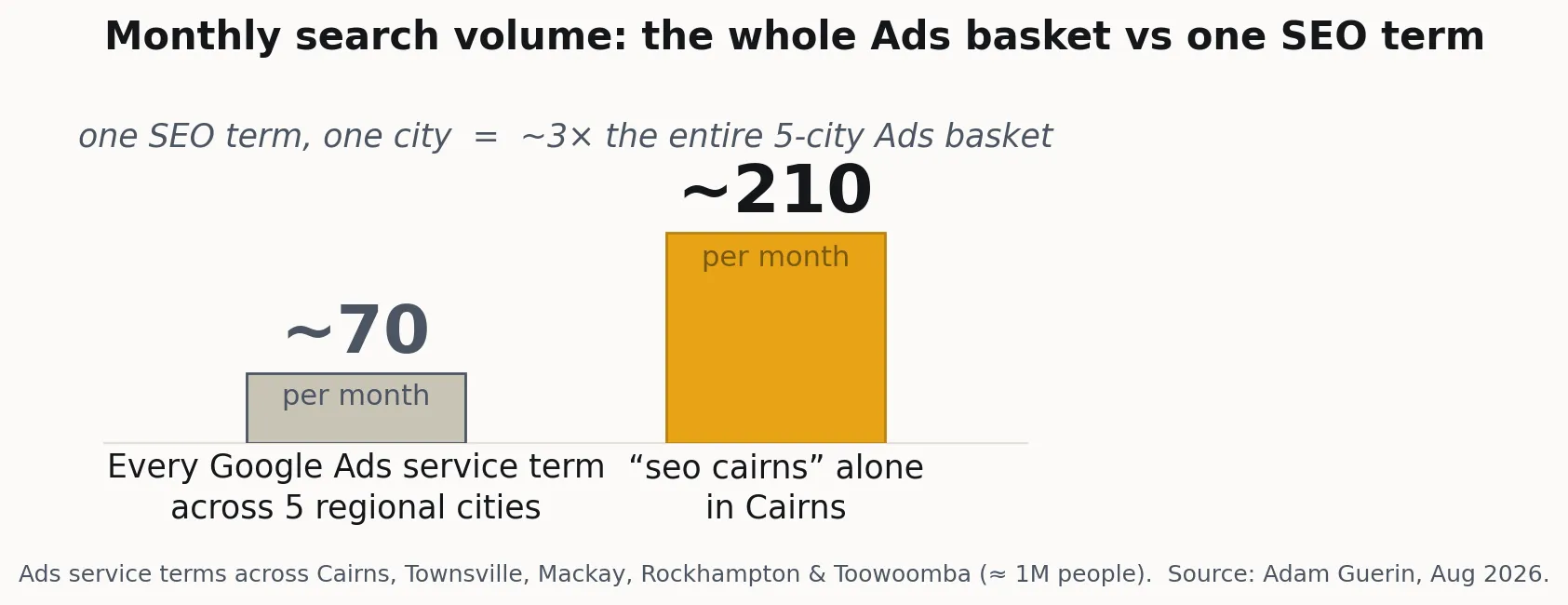
Across all five regional cities, the total addressable monthly search volume for Google Ads service terms came to roughly seventy searches a month.
Seventy. Five cities, close to a million people between them.
For contrast, “seo cairns” on its own runs at something like two hundred and ten searches a month. One term, one city, roughly three times the entire Google Ads keyword basket for the whole cluster. That comparison changed how I weight the two services, and I would not have seen it without running the ladder.
The build
I set the campaign up the way I would for a client, because a sloppy build would have told me nothing.
Five cities, presence-only targeting so it served to people actually in those places rather than people merely interested in them. Search network only, no Display, no Search Partners. Seventy-six keywords across eight tightly themed ad groups, exact and phrase match only. No broad match, because broad match without conversion history spends widest exactly where you have the least control.
Forty-three campaign-level negatives blocking job seekers, students and people after free templates. Conversion tracking wired to real form submissions rather than page views, both actions set as primary, because a badly defined conversion trains the bidding to chase volume over quality.
Two terms came back flagged as low search volume. Everything else was eligible, every ad approved, ad strength from Average to Excellent, no policy or billing issues.
What happened
Over seven days it served zero impressions. The daily budget went untouched.
The number that explains it is in the impression share report. Google attributed the entire loss to Ad Rank and nothing at all to budget. That distinction matters more than the zero does. I was not outspent. There was money sitting there every day. I was out-ranked in the small handful of auctions I was eligible for, and in a market this thin you do not get enough auctions for a modest bid ceiling to win one by chance.
That is the finding I was actually after. Thin volume does not just mean fewer clicks. It removes the mechanism by which a smaller advertiser normally competes. With high volume you can lose most auctions and still get impressions, because there are thousands of them. With seventy searches a month you get a few, they go to whoever has the deepest history and the highest ceiling, and you see nothing.
What this means if you are weighing up Ads
The first question most people ask me is what a sensible monthly budget looks like. It is a fair question, but it assumes the channel works and only the amount is undecided.
The question that actually decides the outcome is whether anyone is searching for what you sell, in the places you can serve, in numbers that make an auction worth entering. If the answer is no, more budget does not help. My own campaign had budget left over every single day and still served nothing.
None of this is an argument against Google Ads. Plenty of businesses around here do very well on it, and the pattern is consistent: urgency plus volume. A cracked windscreen, a broken tooth, a blocked drain, a locked door. People search immediately, they search with intent, and there are enough of them each month to fill a campaign properly. Those accounts work because the demand already exists and Ads simply gets in front of it faster than anything else can.
What Google Ads cannot do is manufacture demand that is not there. It is a capture channel, not a generation channel, and that distinction gets quietly skipped by anyone whose fee depends on you spending.
Before you spend anything
Pull the real monthly volume for your service in your towns. Not nationally, not for the category, for the specific words a buyer would type. Then look at who is already bidding on those terms and ask honestly whether you can clear the auction against them at a figure you can sustain month after month.
If the volume is thin and the competition is funded, the money goes further somewhere it compounds instead of somewhere it is spent per visit.
I am leaving the campaign running with a higher ceiling to see whether that changes anything. If it does not, I will say so here rather than quietly deleting this post.
If you are trying to work out whether Ads is worth it for your business, the numbers come before the pitch. That is where Google Ads management should start, and finding out the channel is wrong for you is a legitimate result rather than a wasted conversation.