Writing
Is SEO Dead? What October 2025 Tells Us
Google posted record revenues and confirmed searches are growing. Here's what October 2025's SEO volatility means for Cairns businesses.
Every few months, someone publishes a piece declaring that SEO is dead. October 2025 gave those arguments a fresh angle: unconfirmed ranking volatility, an AI browser launched by OpenAI, and a search landscape that looks nothing like it did three years ago.
That volatility followed hot on the heels of a September where a single Google change broke rank tracking tools industry wide, so a healthy scepticism of dashboard data was already the right instinct.
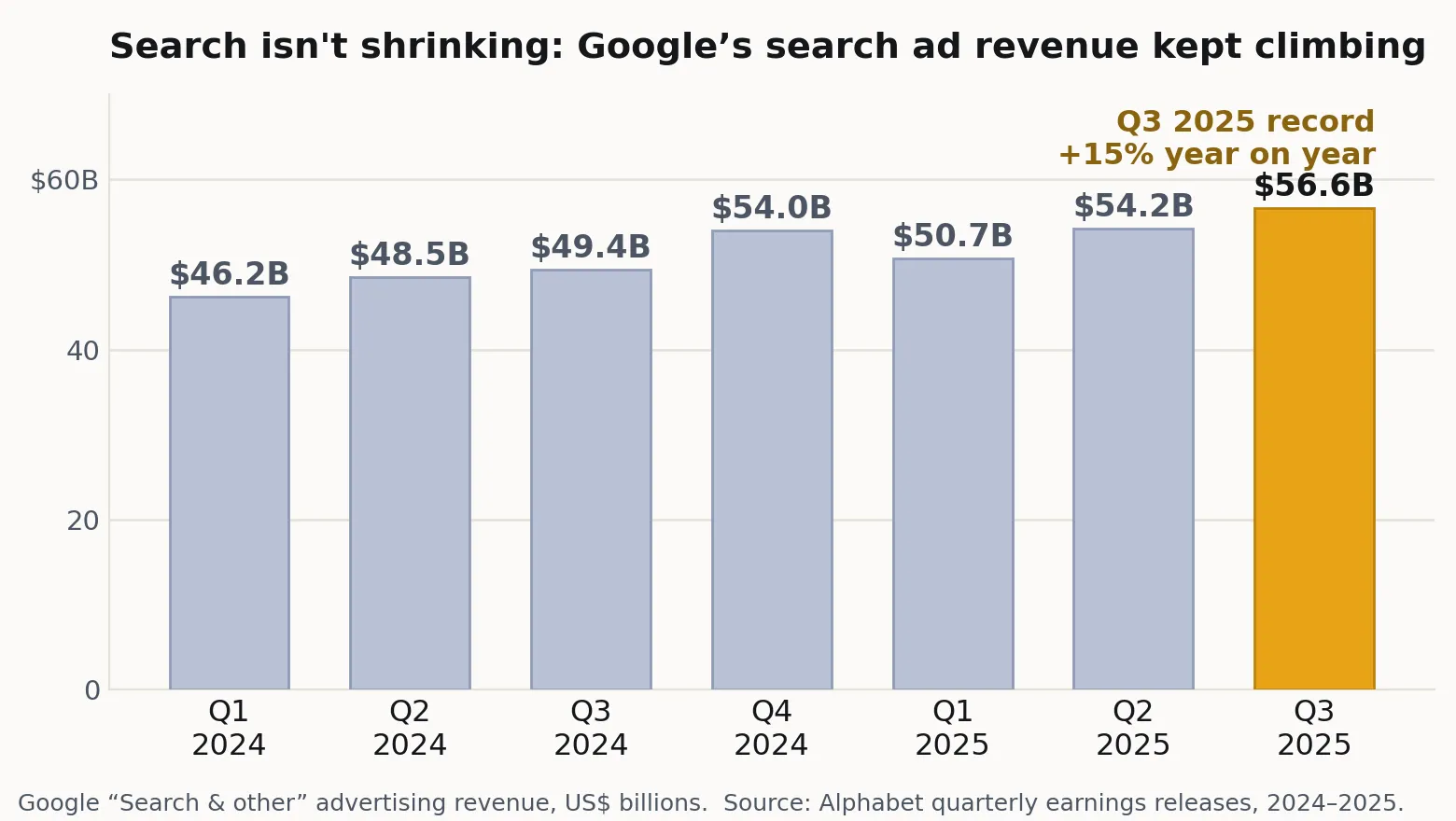
And yet. Google reported record revenues in Q3 2025 and confirmed that the total number of searches happening on Google is increasing. If SEO were dying, you would expect the opposite.
For businesses in Cairns and regional Queensland, October 2025 is a useful moment to separate signal from noise, and to understand what is actually changing, what is not, and where your energy is best spent.
The Ranking Volatility Nobody Officially Explained
October 2025 saw several periods of significant ranking movement. Tracking tools spiked on 7 and 8 October, again between 15 and 17 October, and again around 28 October. Google did not confirm a core update at any of these points.
This kind of unconfirmed volatility is increasingly common and reflects how Google deploys updates, not always in the large, announced packages of previous years but in smaller, more targeted adjustments that collectively add up to significant change.
What the community observed in October’s volatility was consistent with Google’s ongoing direction: thin content pages and sites with weak expertise signals saw the most disruption. Pages with genuine depth, clear authorship, and strong technical foundations were largely unaffected.
There was also a brief Google Search Console outage on 14 October that temporarily prevented crawl data from displaying. Google confirmed data collection was not affected, only the reporting. It is worth noting because outages like this can cause unnecessary alarm. If your Search Console data suddenly looks wrong, always check whether Google has acknowledged a reporting issue before drawing conclusions about your site’s performance.
Google Said the Quiet Part Out Loud
One of the more useful moments from October 2025 came from a public interview with Google’s Robby Stein, who was asked what small businesses should do to appear in AI search results. His answer was essentially: be mentioned in reputable business listings and popular articles.
When the interviewer observed that this sounded exactly like standard SEO, Stein did not disagree.
That exchange matters for regional businesses trying to navigate the noise around AI search optimisation. There is a growing industry of advice suggesting that AI search requires entirely new strategies, new file formats, new content structures, and new technical approaches. October 2025’s messaging from both Google and Microsoft was consistent: the fundamentals of good SEO, meaning clear content, credible mentions, accurate business information and genuine expertise, are the same fundamentals that drive visibility in AI search.
For a business in Cairns, this is clarifying. You do not need to abandon what works and start from scratch. You need to do the basics well, do them consistently, and apply them with a genuine understanding of your local market.
OpenAI Launched a Browser, and What It Actually Means
On 21 October 2025, OpenAI launched ChatGPT Atlas, its own AI-powered browser. The move was widely interpreted as a direct challenge to Google Chrome and Microsoft Edge, and by extension to Google’s dominance over the search experience.
Early reports indicated the browser relied significantly on Google’s own search infrastructure, which somewhat undercut the narrative of existential competition, and raised security concerns that dampened initial enthusiasm.
For businesses in regional Queensland, the honest assessment of ChatGPT Atlas at this stage is: watch it, but don’t act on it yet. The browser has a long way to go before it meaningfully changes how your customers find you. What it does signal is that the browser itself is becoming a new battleground for search and AI discovery, and the companies controlling the browser increasingly control the first point of contact between a user and the web.
This is a longer-term trend worth understanding. Google’s dominance over search has always been reinforced by Chrome’s market share. As AI-powered browsers compete for users, the surfaces through which people discover businesses will diversify. Building a credible, well-structured online presence that performs across multiple discovery channels, not just Google search, is the right long-term response.
Search is Growing, Not Shrinking
The most important data point from October 2025 is one that received less attention than the browser launch and the ranking volatility. Google’s Q3 2025 earnings confirmed record revenues, with Google Search specifically cited as a growth driver. The company stated explicitly that search volumes are increasing.
The dominant narrative in much of the SEO industry is one of decline: traffic falling to AI Overviews, queries being intercepted before reaching websites, the slow erosion of organic click-through rates. That narrative is not entirely wrong. Zero-click behaviour is real and growing.
But total search volume growing means more people are using Google more often. The pie is getting bigger even as the slice that flows directly to individual websites becomes a smaller proportion of it. For businesses with a strong local presence and genuine expertise, that growth creates opportunity, particularly in local and transactional searches where AI Overviews are less dominant.
What October’s Technical Updates Mean for Regional Businesses
October 2025 also reinforced the importance of image and video accessibility as ranking signals. Google’s systems are placing increasing weight on how well visual assets are tagged, described, and accessible to crawlers and screen readers.
For a regional business website, this is often overlooked. Images uploaded without alt text, videos embedded without descriptions, and galleries without meaningful labels are all missed opportunities, both for accessibility and for the technical signals that contribute to how Google evaluates your site.
The fix is straightforward. Every image on your website should have a descriptive alt text that explains what it shows in plain language. Feature images on blog posts, photos of your work, headshots, and location images should all be properly labelled. This is a small investment of time with a meaningful return in technical SEO health.
The Multi-Surface Reality of Search in Late 2025
October 2025 crystallised something that has been building throughout the year: search visibility is no longer a single-channel problem. Google’s traditional results, AI Overviews, AI Mode, Google Maps, Google Discover, and emerging AI browsers all represent distinct surfaces where your business can be found or missed.
For businesses in Cairns and regional Queensland, the practical response is consistency rather than complexity. A well-maintained Google Business Profile, a website with genuine expert content, accurate business information across all platforms, and a steady accumulation of real customer reviews create a presence that performs across all of these surfaces without requiring a separate strategy for each.
The businesses struggling most with the current environment are those that built their visibility around a single tactic, whether a handful of keywords, a high-volume content strategy, or a particular link-building approach. Single-tactic strategies are inherently fragile in a landscape that changes as rapidly as search does.
Building broadly and authentically has held up; it always has.
If you want to understand how your business is positioned across these channels right now, I am happy to take a look.