What Is AEO, and Does Your Small Business Actually Need to Care About AI Search?
You have been told AI is changing everything and you need an AEO strategy. Here is what AEO actually is, why it is mostly just good SEO, and how to spot someone selling you smoke.

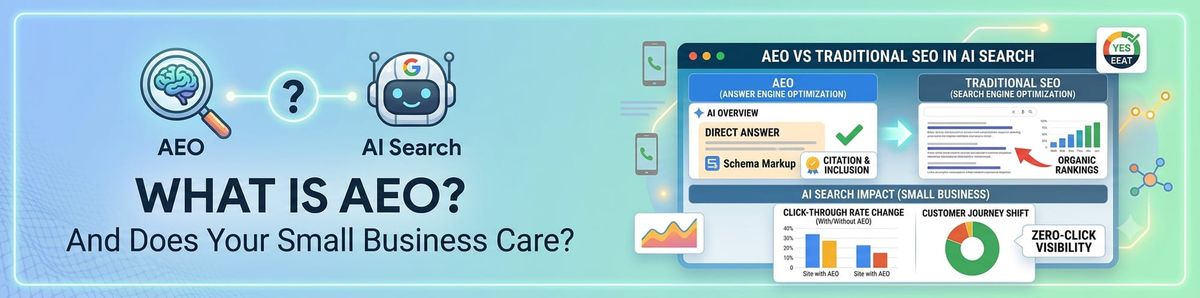
If you have spent any time reading about SEO lately, you have been told that everything is changing. AI is eating search. You need to optimise for ChatGPT. You need an AEO strategy, or a GEO strategy, or whatever the acronym is this month, or you will vanish from Google. A lot of that noise is coming from people who have something to sell you.
So here is a straight answer, the kind I would give a client over a coffee. AEO is real, the way people search is genuinely shifting, and almost none of the special "AI optimisation" tactics being sold are worth your money. Let me explain why, because once you understand how this actually works, you will stop worrying about it and you will know how to spot someone trying to sell you smoke.
What AEO actually means
AEO stands for Answer Engine Optimisation. You will also see GEO, Generative Engine Optimisation. They both point at the same idea, getting your business to show up inside the AI generated answers that now appear at the top of Google and inside tools like AI Mode, rather than only in the old list of blue links.
You have seen these. You search something on Google and before the normal results there is a written answer, assembled by AI, with links out to the sources it used. That is the answer engine. AEO is the work of trying to be one of the businesses that answer cites and links to.
Fair enough as a goal. The problem is what people tell you the work involves.
The thing the hype merchants will not tell you
Here is what Google itself put in writing in 2026, in its own official guidance. Optimising for generative AI search is still SEO. There is no separate system, no secret AI index, no special set of levers. The AI answers are built on top of the exact same search index and the same ranking systems that have always decided who ranks.
It works like this. When you ask Google something, the AI does not invent an answer from thin air. It pulls relevant, current pages from Google's normal search index, the same index that powers the ordinary results, and summarises what it finds, with links back to those sources. It also breaks your question into several related searches behind the scenes to gather a fuller picture. But every one of those searches runs through the same ranking systems as always.
The consequence is simple and it is the whole point of this guide. If your site is not findable in normal Google search, the AI will not find you either. If you do not rank, you do not get cited. There is no back door. The AI is reading the same web, ranked the same way.
So the question "how do I optimise for AI search" has a slightly boring answer. You do good SEO. The same fundamentals that have always worked are the fundamentals that get you into AI answers.
What that actually means for you
For a small business, the work that matters has not changed.
Create genuinely useful content that only you could write, grounded in your real experience, rather than the generic filler that any website or any AI could produce. Google draws a clear line between commodity content, the kind of common-knowledge listicle anyone could churn out, and content with a real point of view from someone who has actually done the thing. The second kind is what gets surfaced, in normal results and in AI answers alike.
Keep your site technically sound so Google can crawl and index it. Get your local foundations right, a complete Google Business Profile and a steady flow of genuine reviews. None of that is new, and all of it is exactly what feeds your visibility in AI search. Doing your SEO well is optimising for AI. They are the same job.
What to ignore
This is where the money gets wasted. Google has been unusually direct about the tactics that do not help, and it is worth knowing them so you can recognise a sales pitch built on nonsense.
You do not need a special file, often sold as an llms.txt file, to feed the AI. Google does not use it. You do not need your content chopped into tiny chunks for the AI to read, because Google already understands a normal page perfectly well. You do not need content rewritten into some special AI friendly version, and you do not need extra structured data or schema purely for AI. And paying for fake "mentions" of your brand scattered around the web does nothing, because the same systems that block spam in normal search apply to the AI answers too.
In 2026 Google went a step further and published a checklist for vetting anyone selling AEO or GEO services. The simplest test from it is this. If someone recommends a tactic, ask them to point to the page on Google's own documentation that supports it. A credible practitioner can. Someone selling proprietary "AI ranking factors" that conveniently only they understand cannot, and that tells you what you need to know.
So does your business need to care?
Honestly, not as a separate, expensive project. You do not need an AEO package bolted onto your marketing. What you need is to be genuinely good at the SEO and local presence that already determine whether customers find you. Get that right and you are, by definition, optimised for AI search. Get it wrong and no amount of AI specific trickery will save you.
The reason I am writing this now is that as AI search grows, more agencies will start selling AEO as a shiny new product at a premium, especially to small businesses who do not have the time to check whether it holds up. Most of it is the same SEO work with a more expensive name on the invoice. You deserve to know that before someone pitches it to you.
Where the judgement comes in
Here is the honest part, the same as every guide in this set. Knowing that AEO is mostly just good SEO is the easy bit. Actually doing the SEO well, consistently, in a competitive local market, is the work.
The judgement is in choosing which content to create so it stands out rather than blending into the commodity pile, getting the technical foundations genuinely clean, building the local signals that matter, and then reading whether any of it is moving you forward. It is also in keeping a level head while the landscape shifts and the next acronym arrives, and knowing which changes are real and which are noise. That mix of doing the fundamentals properly and filtering hype from substance is exactly what is hard to get from an article and what ties straight into your wider local SEO in Cairns and FNQ.
Do not buy the AI panic. Get your SEO right and you are already where you need to be. Working out what "right" looks like for your specific business, and staying ahead as larger players move into this space, is what the training is for.