Writing
Who AI Search Recommends To Your Cairns Customers
I checked what Google's AI actually cites when someone searches for a local service in Cairns. The results should worry more than SEO agencies.
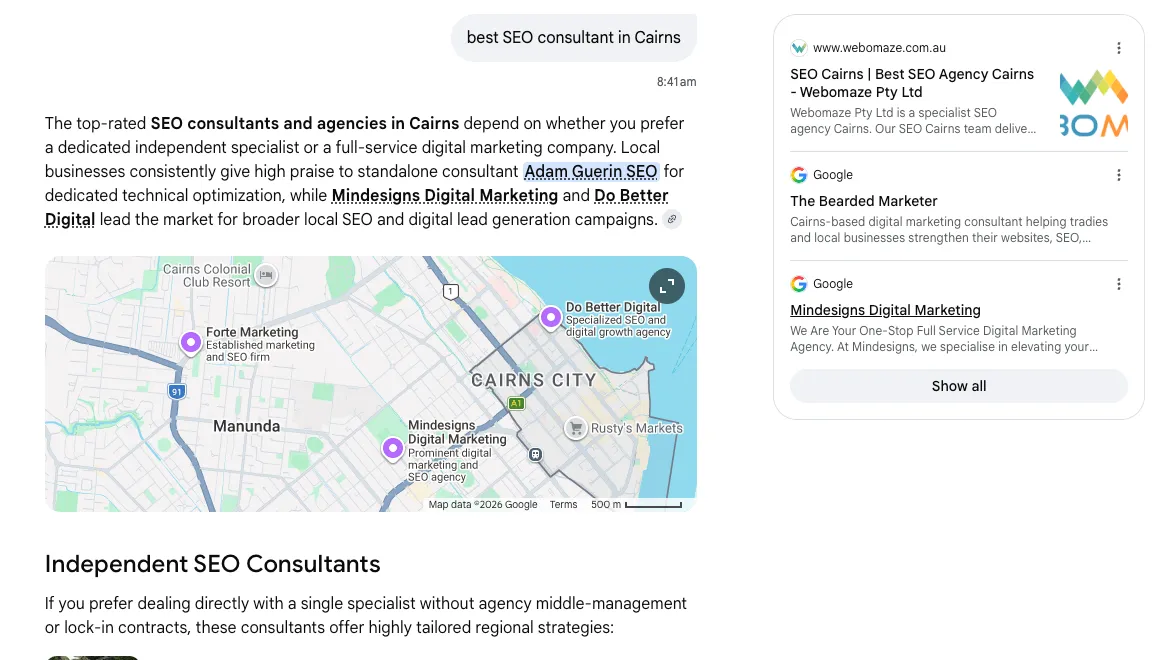
Ask Google’s AI Mode who does your job better than you do, and it will answer. Confidently. With sources.
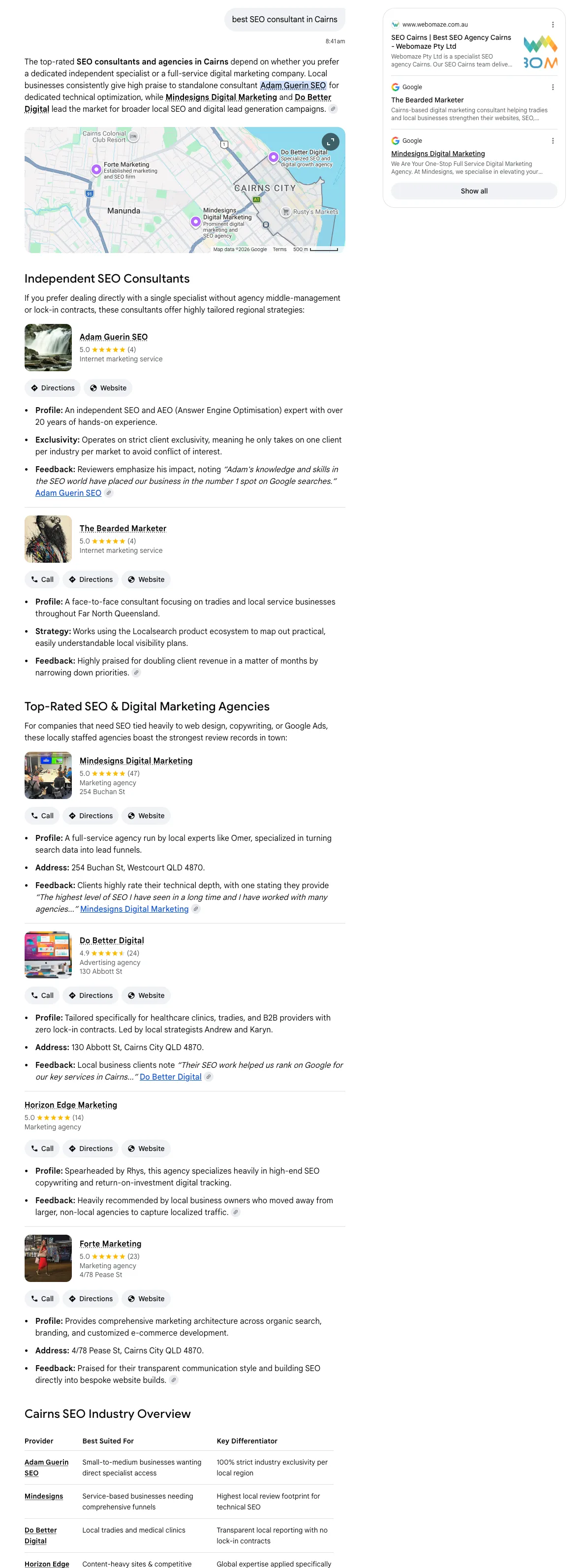
The question is whether those sources are any good.
I run SEO and AEO work for businesses across Cairns and FNQ, and I wanted to know what AI search actually recommends when someone searches for a service like mine. Not what I assume happens. What actually happens, checked against real data. The groundwork for all of this was laid over 2025, and I wrote a longer wrap on how AI took over search and where that leaves businesses in 2026.
How AI search picks who to mention
AI Overviews and AI Mode don’t invent answers from nothing. They pull from Google’s existing search index, retrieve a handful of relevant pages, and generate a response grounded in what those pages say. Complex questions can trigger a fan-out into several related searches behind the scenes, all feeding the one answer.
What matters for a local business is this: the AI is only ever as good as what it’s been trained to trust. If your industry’s search results are dominated by directories, national aggregators, and agencies with no actual presence in your town, that’s what gets cited. Not because it’s the best answer for someone in Cairns. Because it’s the content the system has learned to reach for.
Nobody tells you this is happening. Most business owners have never seen the list.
What I found when I checked my own category
I tracked a set of AI search prompts covering the kind of terms a Cairns business owner would actually type. Best SEO consultant Cairns. Local SEO specialist Cairns. Who does SEO for small businesses in Cairns. That range.
The citation data threw up a clear pattern. The most frequently cited sources across those prompts weren’t Cairns operators. They were larger agencies and directory-style listings with no specific Cairns presence, appearing again and again across multiple prompts. A handful of genuine local competitors did show up further down the list, but they weren’t the businesses AI search was reaching for first.
My own site is still young, so my absence from that list tells you nothing useful yet. What’s genuinely useful is the shape of the list itself. AI search, for this category, was citing scale and existing search visibility over local relevance. A Cairns customer asking who to call was being pointed toward businesses that have never worked a Cairns account.
This isn’t unique to SEO
I only had visibility into my own industry because I have the tools to track it. But the mechanism that produced this result doesn’t care what industry it’s operating in.
The same pattern plays out for a family lawyer, a plumber, a physio, a cafe. Whichever local operators have the strongest existing search presence, structured content, and enough of a digital footprint to have been indexed and cited before, those are the ones AI search reaches for. Being genuinely good at the job and being the one the AI recommends are two separate things, and there’s no guarantee they line up.
If you’ve never checked what AI search says about your own trade in Cairns, you’re currently trusting that the gap doesn’t apply to you.
A five minute check you can run yourself
Open ChatGPT, Google AI Mode, or Gemini and search “best [your trade] Cairns” or “who does [your service] in Cairns”. Read what comes back. Note which businesses are named, and whether any of them are actually local. Run it again with a nearby town if you serve Port Douglas or Mareeba as well.
You’ll usually get one of three outcomes. You’re named, and the answer is accurate. You’re not named, but a genuine local competitor is. Or you’re not named, and neither is anyone from your town, just a wall of directories and agencies with no address anywhere near you.
Each of those tells you something different about where you stand, and none of them are things you’ll find out by checking your Google rankings alone. Not showing up at all is a different problem, and I’ve covered what to do about it separately.
Where this leaves you
AI search citation is not the same discipline as ranking in classic search results, though the two are related. It rewards the sites that are already structured for it, already indexed cleanly, and already carrying the kind of first-hand, locally grounded content that gives an AI system a reason to trust them over a directory listing.
That’s the work I do through AEO consulting, and it starts with exactly the check above. Knowing what AI search currently says about your business is the first fact you need before deciding whether anything needs to change.
Get in touch if you’d like to talk this through.